Conference Theme
The conference theme further develops an academic community interested in implementation and replication research in mathematics education. The goal is to co-construct norms for conducting high-quality implementation and replication research by helping each other explore and enact these norms in the practice of academic writing.
This is a “flipped” conference: Little time will be spent showcasing the polished front pages of our studies or providing feedback on the finished work. Instead, the conference will be devoted to supporting each other in developing the critical parts of our future publications. In that sense, we will jointly engage in the foundational work that will lead to journal publications.
Hence, the conference can be seen as a combination of an academic writing workshop for researchers at all levels of experience and a collective inquiry into how the kind of research we aim to support can be conducted and reported in a scholarly manner. The focus is on maintaining academic integrity while supporting and understanding the processes where insights produced by research are brought into mainstream implementation in mathematics education practice.
Conference Program
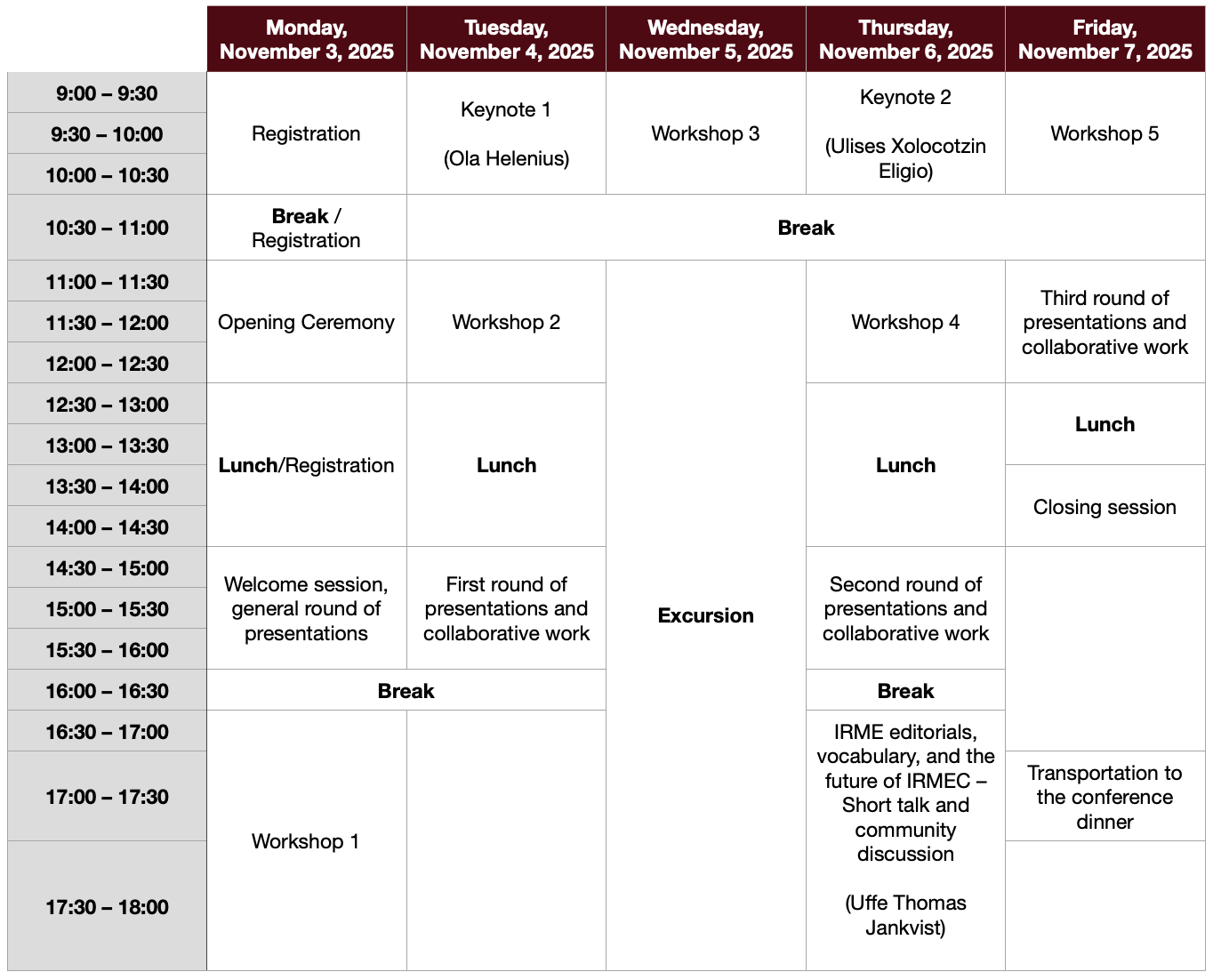
Detailed Conference Program
Access the detailed program in PDF format here
Conference Recordings and Highlights
Welcome Session and General Round of Presentations
Slides from the session “IRME editorials, vocabulary, and the future of IRMEC”
Description of Workshops
Workshop 1
Academic writing with AI (Morten Misfeldt, University of Copenhagen, Denmark)
Workshop 2
Reporting replication studies (Mario Sánchez Aguilar, Instituto Politécnico Nacional, Mexico)
Workshop 3
Reporting implementation studies (Linda Marie Ahl, University of Gothenburg, Sweden)
Workshop 4
A checklist for writing a discussion (Uffe Thomas Jankvist, Aarhus University, Denmark)
Workshop 5
A checklist for writing an introduction (Boris Koichu, Weizmann Institute of Science, Israel)
Paper Presentations (Overview)
Participants will present their work on implementation and replication in mathematics education. These sessions encourage collective dialogue on methods, results, and implications across diverse educational contexts.
| Tuesday, November 4, 2025 | Thursday, November 6, 2025 | Friday, November 7, 2025 | |
| Group ProME | + Linda Marie Ahl + Mathias Tejera + Carlos Aurelio Robles Amador | + Enrique Ceballos Alexis + Mathilde Kjær Pedersen | + Guadalupe Mariscal-Muñoz + Morten Misfeldt |
| Group Sala Azul | + María del Carmen Fajardo Araujo + Maria Kirstine Østergaard + Olimpia Isaura Gómez Pérez | + Cristian Nava-Guzmán + Verónica Vargas Alejo | + Juan Gabriel Herrera Alva + Alan Reyes-López + Boris Koichu |
| Group Sala Auditorio | + María-José Aviña-González + Andreas Lindenskov Tamborg + Viviana Aharonian | + Verónica Hoyos + Alon Pinto | + Alejandro Bañuelos Soberanis + Uffe Thomas Jankvist |
| Group Sala ProFE | + Edgar Roberto Rossainz Montiel + María de Lourdes Santana Salinas | + Elizabeth Rosales González +Eleany Barrios Borges | + Yolanda Chávez Ruiz + Irenisolina Antelo López |
Plenary sessions
IRMEC features two plenary talks: one on the challenges of implementing research in practice, and another on the role of replication studies in mathematics education.
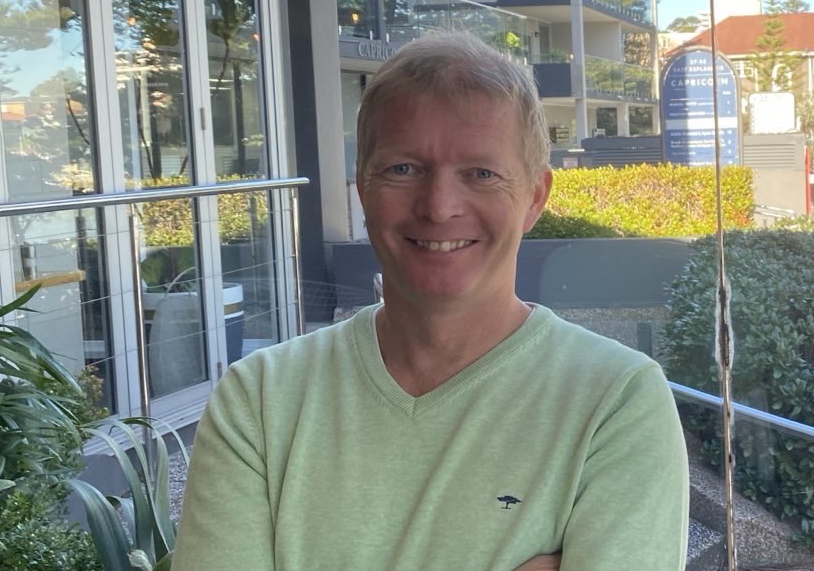
Ola Helenius
University of Gothenburg, Sweden
“Implementing content-based mathematics teaching innovations at scale”
Since at least the 80’s, research has pointed out school algebra as a specifically important area of mathematics but also a specifically difficult area to teach and to learn. The general recommendation from research has been to introduce algebraic thinking earlier, in the form or early algebra or pre-algebra. The project Algebra Monday is a strategy for improving the teaching of algebra and structural arithmetic throughout the school system which is currently implemented in four municipalities in Sweden. Designing a comprehensive strategy for teaching structural arithmetics and algebra involves some serious analytic work in terms of the presentation of the mathematical content. Such work needs solid support in terms of theories that can be put to work for structuring long term conceptual progressions. However, even more challenging is how to design for implementation: Implementation with teachers in schools, and with schools in school systems. When designing the implementation strategy for Algebra Monday we took advantage of experience from several previous large- and medium-scale projects and from working with scaling of design-based small-scale projects. But just as importantly is what we have learned from the international implementation science research. The choices we made led us to a strategy that can be describes as minimally intrusive in relation to teachers existing routines but highly intrusive in relation to the local school- and school-system organization.
In the talk I will discuss our choices for the following three components of Algebra Monday and how they interrelate
- the design of materials for teachers to allow for a teacher adaptations while keeping the core determinants functional
- the development of local scaling strategies and building up of local multiplier structures, that is, a collegial group of teachers with previous experience of Algebra Monday that can be leaders of new collegial groups
- the setup of stakeholder scaffoldings, that is, local project organizations that support development, scaling and sustainment
I will conclude with some ideas for how the project can be scaled up further.
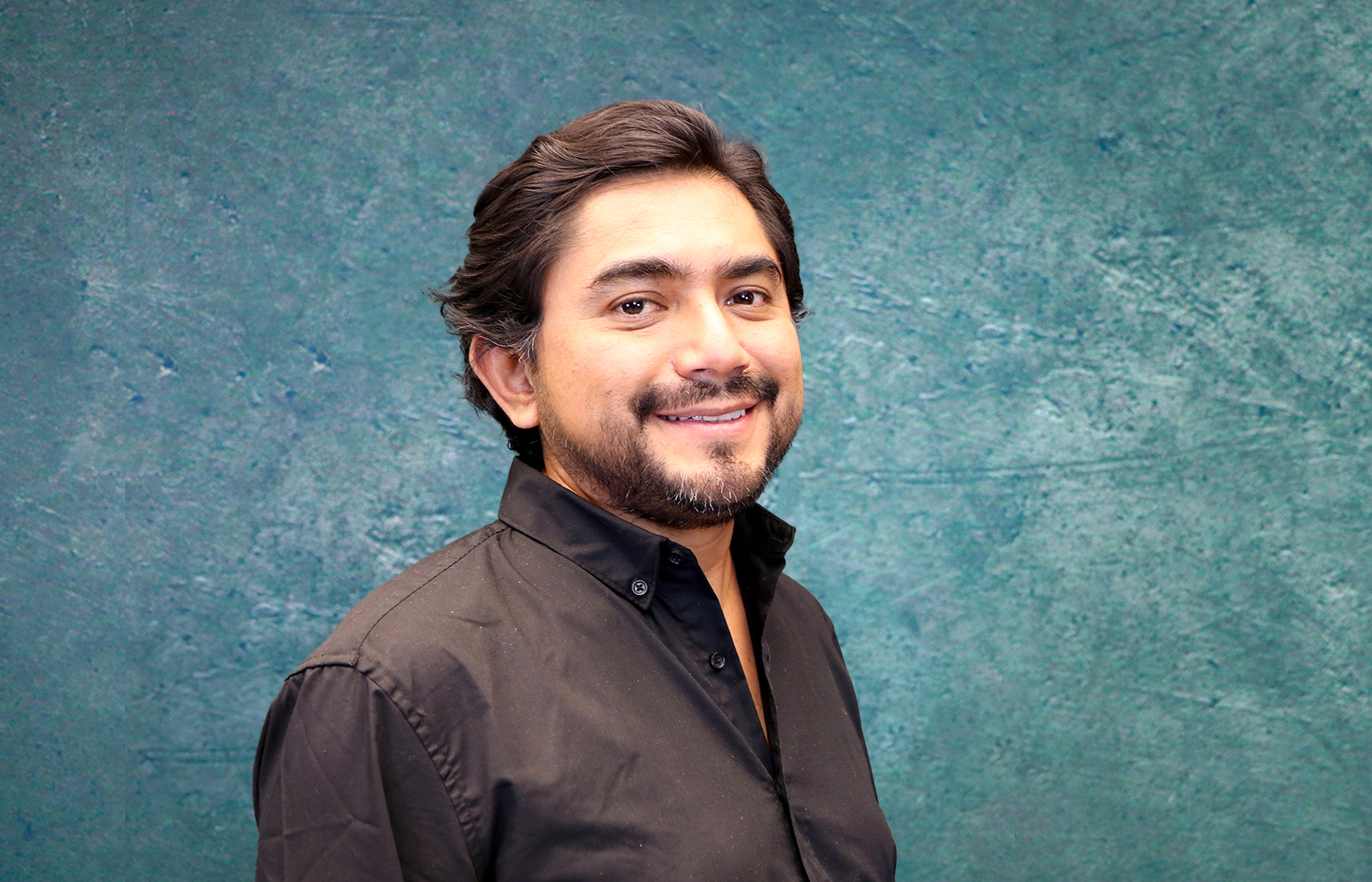
Ulises Xolocotzin Eligio
CINVESTAV, Mexico
“Exploring the potential benefits of replication-based learning for Mathematics Education graduate students”
Replication practices are starting to attract interest amongst the Mathematics Education community. However, the challenges and potential promises involved in establishing a culture of replication remain largely unclear. Therefore, more work is needed to define which replication practices are adequate and relevant for conducting mathematics education research. In this talk, I will describe some of the insights learned in the adjacent field of Psychology, in which the so-called “replication crisis” has precipitated positive and meaningful changes in methodological and publication practices. I will conclude by outlining how some of the replicability-oriented research practices learned in Psychology might help find ways of using replication to advance the development of Mathematics Education research programs.
 IRME Conference